

Expect the Unexpected: The Disruptive Power of Low-carbon Technology
Sign up today to download
the full report
This report was produced in partnership between Carbon Tracker and the Grantham Institute at Imperial College London.
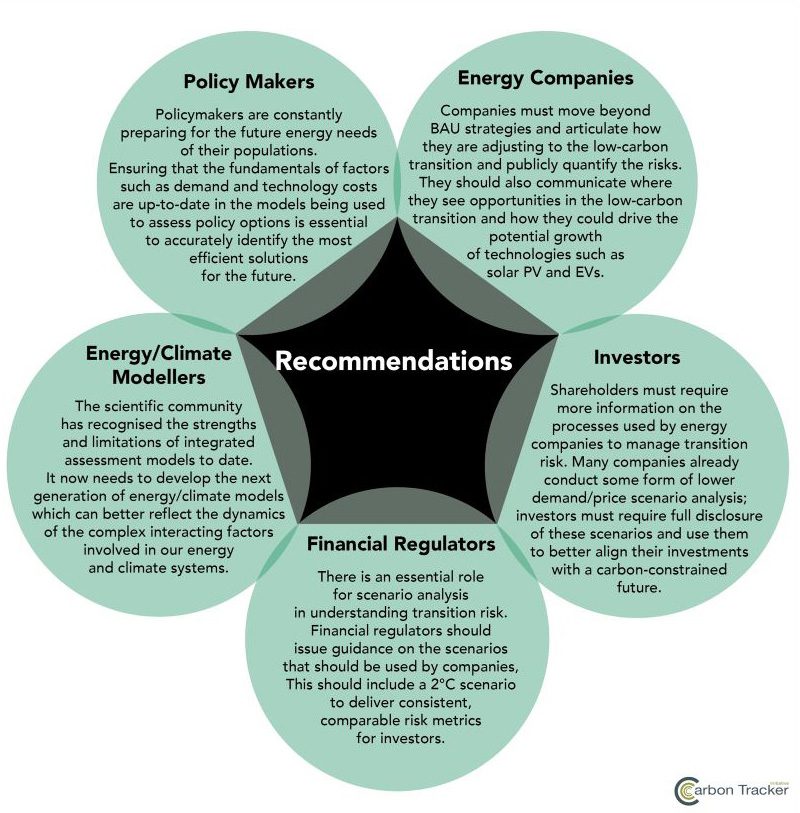
The study analyses the potential for continued cost reductions in solar photovoltaics (PV) and electric vehicle (EV) technologies to displace demand for currently dominant fossil fuels and mitigate CO2 emissions. In doing so, the report reviews the validity of continuing to base corporate strategies on ‘business as usual’ scenarios.
EXPLORE THE INTERACTIVE TOOL: This accompanying online interactive dashboard allows readers to delve into the scenario results:
carbontracker.org/expect-the-unexpected-dashboard
Updating model assumptions is critical
This study demonstrates the importance of using the latest available data and market trends for technology costs and climate policy in energy modelling. Applying up-to-date solar PV and EV cost projections, along with climate policy effort in line with the Nationally Determined Contributions (NDCs), should now be the starting point for any scenario analysis. This is not a radical disruptive scenario in terms of its inputs, but a reflection of the current state of play. The key findings in this scenario are presented below. Low-carbon technologies- Solar PV (with associated energy storage costs included) could supply 23% of global power generation in 2040 and 29% by 2050, entirely phasing out coal and leaving natural gas with just a 1% market share. ExxonMobil sees all renewables supplying just 11% of global power generation by 2040.
- EVs account for approximately 35% of the road transport market by 2035 – BP put this figure at just 6% in its 2017 energy outlook. By 2050, EVs account for over two-thirds of the road transport market. This growth trajectory sees EVs displace approximately two million barrels of oil per day (mbd) in 2025 and 25mbd in 2050. To put these figures in context, the recent 2014-15 oil price collapse was the result of a two mbd (2%) shift in the supply-demand balance.
- Although this study focuses on the decarbonisation of the global power and road transport sectors, which today account for only 51% of global CO2 emissions and fossil fuel demand approximately, this scenario sees:
- Coal demand peaking in 2020;
- Oil demand peaking in 2020; and
- Gas demand growth curtailed.
 Explore below how different policy, technology cost and energy demand assumptions affect installed solar PV capacity in our scenarios, and how these compare against other industry projections.
This study looks at the impact of low-carbon transformations in power and road transport, sectors which together account for just 50% of global fossil fuel demand and CO2 emissions approximately. Nevertheless, growth of solar PV and EVs significantly curb coal, oil and gas demand in our scenarios. Compare these against other industry projections below.
Explore below how different policy, technology cost and energy demand assumptions affect installed solar PV capacity in our scenarios, and how these compare against other industry projections.
This study looks at the impact of low-carbon transformations in power and road transport, sectors which together account for just 50% of global fossil fuel demand and CO2 emissions approximately. Nevertheless, growth of solar PV and EVs significantly curb coal, oil and gas demand in our scenarios. Compare these against other industry projections below.
Quotes
Nick Butler, Financial Times blog: “This is not an advocacy document or wishful thinking but a well-sourced projection based on what is already happening. It deserves to be read by everyone working in the energy sector, by policy makers and perhaps most urgently by investors. Its conclusions really do qualify for inclusion in the overused category of ‘breaking news’.”
Luke Sussams, senior researcher at Carbon Tracker: “Electric vehicles and solar power are game-changers that the fossil fuel industry consistently underestimates. Further innovation could make our scenarios look conservative in 5 years’ time, in which case the demand misread by companies will have been amplified even more,”