Canada’s oil and gas sector faces revenue risk from demand decline
New analysis warns investors and provinces of financial risks
Press Release | 20/11/25 | Oil & Gas

How oil- and gas-dependent Canadian provinces face fiscal strain as the energy transition progresses
Canada’s oil- and gas-dependent provinces face growing fiscal risks as the energy transition reduces fossil fuel demand and pressures prices. This report examines how declining oil and gas revenues could affect provincial budgets, finding that revenues could fall by 82% in a Paris-aligned scenario. It highlights the need to diversify into clean energy and critical minerals, build fiscal reserves, and manage the risks of new fossil fuel projects.
A number of Canadian provinces – particularly Alberta, but also Saskatchewan, British Columbia, and Newfoundland and Labrador – have generated significant tax revenue from oil and gas over the years. The new federal government has signalled stronger support for the sector, seemingly based on expectations of continued strong demand. However, the energy transition presents a long-term threat to the sector: provincial governments need to prepare for a future of lower oil and gas demand and shrinking fossil fuel revenues.
This report evaluates how the energy transition could affect provincial government revenues, outlining key policy developments and sectoral risks. It also examines challenges in scaling up CCUS and highlights opportunities to diversify tax bases through transition-resilient sectors.
“Rising deployment of clean energy and electrification of transport threaten to wipe out future tax-take, as high-cost Canadian production struggles to compete globally. Diversification into transition-resilient sectors is the safest route to maintaining fiscal stability.”
The energy transition could wipe out over 80% of Canadian provincial governments’ expected revenue from upstream oil and gas in the 2030s.
Canada’s high-cost oil and gas production will increasingly be squeezed as clean energy and transport electrification curb demand and put downward pressure on global prices.
Carbon capture, utilisation and storage would not insulate the sector from demand substitution, even if successfully deployed.
At both a provincial and federal level, Canada needs to diversify its tax base. Clean energy and critical minerals are major growth sectors which will generate long-term revenues.
Several proposed oil and gas upstream projects would likely be uneconomic in a moderate-paced transition, and incompatible with the Paris Agreement goals, which risks failing to generate expected government tax-take.
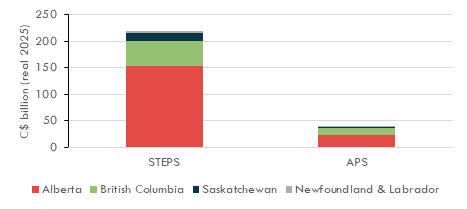
Provincial oil and gas revenues collapse in a Paris-aligned world – total cumulative upstream oil and gas revenues to provincial governments in 2030–39 fall from an expected C$218bn to C$39bn, an 82% reduction.
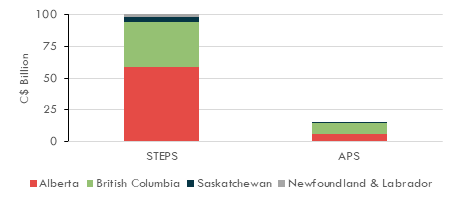
Both existing and new projects are vulnerable – pre-FID upstream oil and gas projects are projected to deliver around C$100bn in combined royalty and income tax payments between now and 2040 under a business-as-usual scenario, but only about C$20bn in a Paris-aligned transition.
Dive into the full report for detailed analysis of how the global energy transition could impact Canadian provincial budgets, and what policymakers can do to manage the fiscal risks. Use the download button at the top of this page.
This report is one of a two-part series analysing the value of Canadian oil and gas amid the unfolding energy transition. The second report explores whether investment in new upstream projects risks eroding Canadian oil and gas value. It benchmarks Canadian firms against global peers to determine relative positioning and provide a view on risk exposure in a worldwide context. Read Fading Fortunes here.

“Provincial governments need to prepare for a future of lower oil and gas demand,” said Rich Collett-White, Carbon Tracker Analyst and lead author. “Rising global deployment of clean energy and electrification of transport threaten to wipe out future tax-take, with high-cost Canadian production likely struggling to compete globally. Diversification into transition-resilient sectors is the safest route to maintaining fiscal stability.”
True Oil & Gas Value in Canada and Beyond