New analysis shows the sector is approaching a commercial tipping point in the early 2030s that will trigger a rapid shift to battery-electric trucks and reshape competition across the global truck...

Login
Don't have a login?

Trucking’s Tipping Point
Why the Truck EV Transition is Closer Than Expected
Overview
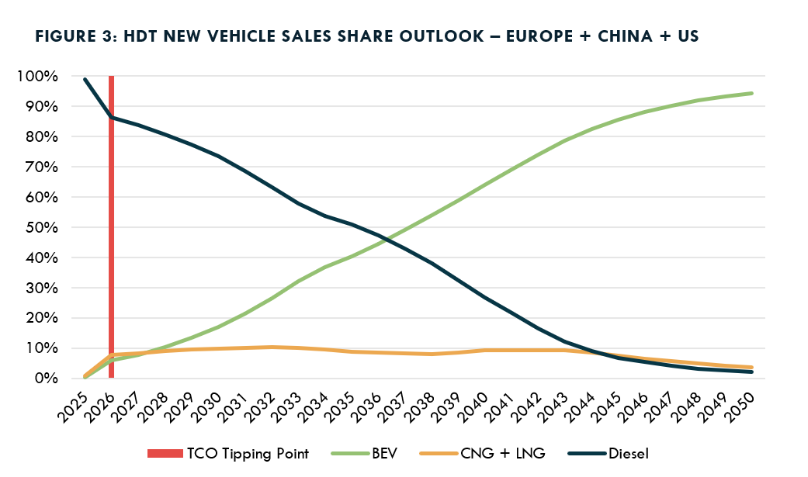
Heavy-duty transport has long been considered as one of the hardest sectors to electrify. Carbon Tracker’s analysis finds that this assumption is increasingly at odds with the economics of commercial freight. Falling battery costs, manufacturing scale and improving operating economics are bringing battery-electric trucks towards total cost of ownership (TCO) parity with diesel across major markets, with key tipping points expected by the early 2030s. Once parity is reached, adoption is unlikely to proceed gradually.
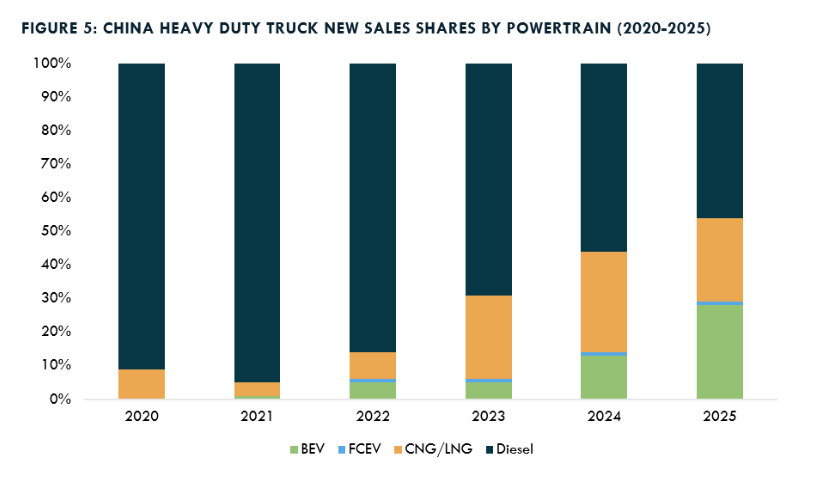
The analysis indicates that electric truck sales can accelerate rapidly along a non-linear S-curve, creating transition risks for manufacturers with large exposures to internal combustion technology and opportunities for companies better positioned for an increasingly electric market. China provides an early indication of the speed at which this transition can unfold. Battery-electric trucks accounted for more than 30% of Chinese heavy-duty truck sales in 2025, up from around 1% in 2021, demonstrating how quickly market share can shift once commercial economics become favourable.
Sign up today to download
the full report
Key findings
1
Heavy-duty freight could electrify sooner than consensus assumptions suggest. China’s battery-electric truck market has already moved from around 1% of sales in 2021 to more than 30% in 2025, providing a real-world example of how quickly adoption can accelerate.
2
Total cost of ownership, rather than regulation alone, will determine the pace of the transition. As battery costs fall and operating economics improve, battery-electric trucks are expected to reach or surpass diesel on TCO across major markets by the early 2030s.
3
The main investment risk lies in the speed of adoption after cost parity is reached. The modelling indicates a steep S-curve, meaning diesel margins, legacy manufacturing assets and incumbent market positions could come under pressure before electric trucks become the majority of new sales.
4
China is likely to shape the global competitive landscape as well as its domestic market. Its rapid electrification is helping manufacturers build scale, reduce costs and develop technologies that can support expansion into international freight markets.
5
Electrification is changing the basis of competition between truck manufacturers. Electric-first players and non-traditional competitors are gaining ground through different manufacturing models, software architectures, supply chains and technologies such as battery swapping, reducing the value of some incumbent advantages built around internal combustion platforms.
Graphs:
Related resources
Additional Files
Quotes

Ben Scott, Head of Energy Supply at Carbon Tracker said: "Heavy-duty trucking has long been regarded as one of the hardest transport sectors to electrify. While important barriers remain, including charging infrastructure, our analysis shows that improving total cost of ownership will dictate the speed of the trucking EV transition. Investors should not underestimate how quickly adoption could accelerate once those commercial tipping points are reached and should be asking whether manufacturers have credible strategies to compete in an increasingly electric market.”